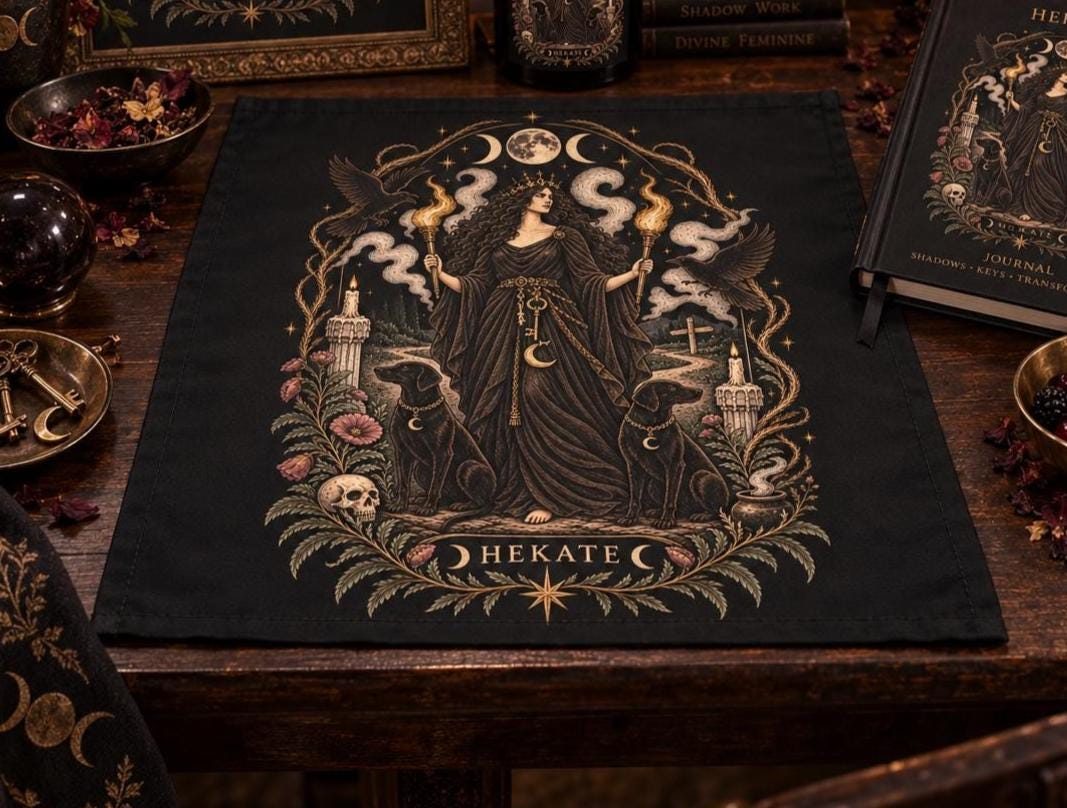
Hekate is the Greek goddess of the crossroads, thresholds, the night, and witchcraft. She is also one of the most-searched deities for home altars, and the questions are always the same: what goes on it, where it goes, and what to offer. This guide answers those with what is traditional, what is common modern practice, and where you have room to choose.
Start with three things
An altar does not have to be large or complete. A working Hekate altar can be a shelf, a windowsill, or the top of a dresser with:
- A defined surface. A cloth, tray, or board that marks the altar as separate from the rest of the room. Black is traditional for Hekate; a printed cloth also gives the space a focal image.
- A light. A candle or a small lamp. Hekate carries torches, and a flame is the simplest way to say the altar is active.
- One of her symbols. A key, a small torch or candle pair, a dog figure, a crossroads or three-way image, or a representation of her triple form.
Everything below builds on those three.
Set an intention first
Before you buy or arrange anything, decide what the altar is for. One sentence is enough, and it can be plain: *protection for this house*, *help at a crossroads in my life*, *a place to grieve*, *learning the craft*, *honoring her*. Say it out loud the first time you light the candle, and write it in the journal if you keep one.
The intention does three things. It tells you what belongs on the altar and what is clutter. It gives the offerings a direction. And it gives you something to check against in a month: is this still what the altar is for, or has it changed? Either answer is fine. Re-state the intention when it changes.
Go by your gut
Everything in this guide that is called "traditional" comes from ancient Greek practice or from long-standing modern use. None of it is a rule you owe anyone. If a symbol on the list feels wrong and a stone you found on a walk feels right, the stone goes on the altar. If black feels heavy in your room and deep red feels alive, use red. If the Deipnon meal feels like too much and a lit candle and a few words feel honest, that is the offering.
Devotional practice works when it is yours. When tradition and instinct disagree on your own altar, instinct wins. Use the traditional material as a starting vocabulary, not a checklist.
Her symbols and what they mean
- Keys. Hekate holds the keys to thresholds, gates, and the underworld. An old iron key, or a set of three, is the most common altar object for her.
- Torches. Usually two, one in each hand, lighting the way at night. Two candles on the altar stand in for them.
- Hounds. Dogs are her companions and her animal. A small dog figure, or a black dog image, belongs on the altar. Dog-related offerings are traditional.
- The crossroads. Especially the three-way crossroads, where her shrines stood in antiquity. A "Y" drawn or laid in twigs, or a three-armed arrangement of objects, represents it.
- The triple form. Hekate is often shown as three figures back to back, looking down each road. A triple-moon symbol is a modern shorthand for this.
- Hekate's wheel (the strophalos). A serpent-like spiral inside a circle, associated with her in later antiquity. Common on modern altar cloths, candles, and jewelry.
- Plants and animals. Garlic, yew, cypress, mandrake, and poppies appear in her lore. Snakes and owls sometimes accompany her alongside dogs.
You do not need all of these. One or two, chosen deliberately, read more clearly than a crowded surface.
What to place on the altar
A typical modern Hekate altar has some mix of:
- Cloth — black or dark, sized to the surface. A 22 × 22 inch cloth covers a small tabletop; a 10 × 10 inch cloth marks a shelf or windowsill. See the altar cloth size guide.
- Candles — black, white, or red are the usual choices. Two for her torches, or one central candle. Use holders on a heat-safe surface.
- Keys — real ones, ideally old or iron.
- A dog figure or image.
- An image of Hekate — a print, card, statue, or the illustration on the cloth itself.
- An offering dish — a small bowl or plate for food offerings.
- A journal or grimoire — for recording offerings, readings, and dreams, if that is part of your practice.
- Incense — myrrh, frankincense, storax, or a dark resin blend are traditional-leaning choices; any incense you associate with night work is fine.
- Crystals or stones — black tourmaline, obsidian, and moonstone are the most common modern associations. None are historical; use what you like.
Offerings and the Deipnon
The best-documented practice for Hekate is the Deipnon, a meal left for her at the end of the lunar month, at the dark moon, the night before the new moon appears. In ancient Athens households cleaned the home and left food at the crossroads shrine.
A home version:
- Clean the altar and the space around it. Dust, wipe, replace burned-down candles. The Deipnon is as much about clearing out as it is about giving.
- Leave food or drink. Traditional items: garlic, eggs, bread, cheese, fish, honey, and cakes. Modern practitioners also leave wine, olive oil, a portion of their own dinner, or a small glass of vodka or another clear spirit. Honey and spirits are the two most common offerings on home altars today because they keep, they pour, and they feel like giving something of value.
- Light the candles, say whatever you say, and let the offering sit overnight.
- Dispose of it the next day without looking back — outdoors at a crossroads if you can, or in compost or the bin if you cannot. The "don't look back" part is old and widely kept.
Between Deipnons, small offerings work: a lit candle, a spoon of honey in the dish, a splash of wine, vodka, or water, incense, or a few words at the threshold of your door. Change liquid offerings within a day or two; a dish that has gone sticky or sour is the opposite of an offering.
Where to put a Hekate altar
- A threshold. Near the front door, an entryway, or a hallway junction fits her role as keeper of gates.
- A north- or west-facing spot is a common modern preference for night and underworld deities, but there is no rule.
- Outdoors at a crossroads is the ancient location. A path junction in a garden works.
- A shared or small space. A single shelf with a cloth, a candle, and a key is a complete altar. It does not need to be visible to visitors to be real.
Keeping it working
- Clean it at each dark moon. This is the one maintenance rhythm that comes from the historical practice.
- Replace, don't accumulate. When a candle burns out, replace it. When an offering is done, remove it. An altar that only gains objects stops being a working space.
- Keep flame away from fabric. Candles in stable holders, on a tile or plate, with the cloth as backdrop rather than base.
- Let it change. People add a key when they move house, a dog figure after a loss, a new image when their practice shifts. That is the altar doing its job.
Frequently asked questions
Does a Hekate altar have to be black?
No. Black is the traditional and most common color for her, but dark blue, deep red, and purple are also used. Choose the color that makes the space feel set apart to you.
What are the best offerings for Hekate?
Garlic, eggs, bread, honey, cheese, fish, wine, and olive oil are the traditional foods. Honey and a clear spirit such as vodka are the most common modern offerings. Candles and incense are the everyday offerings between Deipnons. Dog-related offerings, such as a donation to a shelter, are a common modern addition.
When is the Deipnon?
At the dark moon, the last night of the lunar month, before the first sliver of the new moon is visible. Many practitioners simply use the calendar new-moon date.
Can I keep a Hekate altar in a small apartment?
Yes. A shelf or windowsill with a cloth, a candle, and a key is a full altar. Size does not matter; a defined surface and regular attention do.
Do I need a statue?
No. A printed image, an altar card, or the illustration on a cloth serves the same purpose. Many people begin without any image at all and add one later.