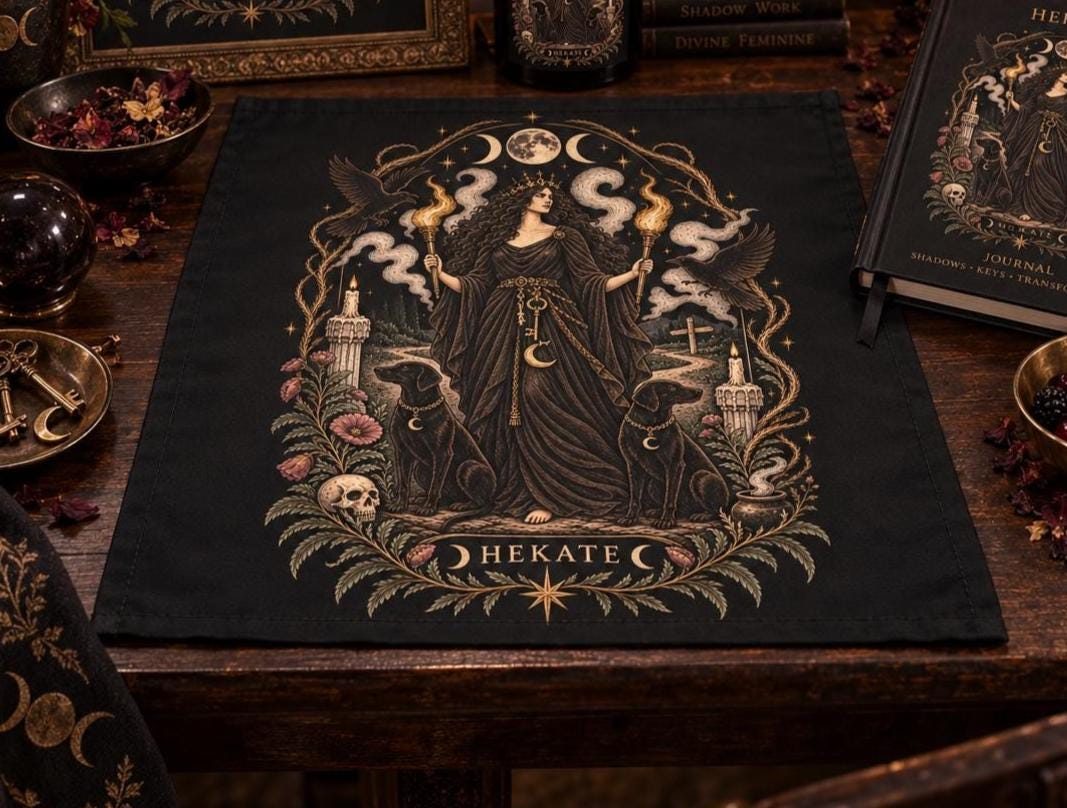
Hekate has one of the richest sets of symbols of any Greek deity, which is exactly why altars dedicated to her can get crowded. This guide goes through each symbol, where it comes from, what it means, and how people use it today, so you can choose the ones that belong on your altar, in your journal, or on the art you keep near you.
Keys
The key is the symbol most tied to Hekate. In antiquity she was called *Kleidouchos*, the key-bearer, holding the keys to the underworld, to the gates between worlds, and by extension to any threshold. A key on an altar asks for passage: into a new phase, through a hard decision, past a block.
In practice, people use an old iron key, a set of three, or a key worn as a pendant. On a cloth or a print, the key usually hangs beside the torches or crosses the triple moon.
Twin torches
Hekate is almost always shown carrying two torches, one in each hand. They are the light that lets you see at a crossroads at night, and they recall her role in the myth of Persephone, where she carried torches to help Demeter search the dark for her daughter.
Two candles on an altar stand in for the torches. Black, white, or red are the usual colors. Lighting them is the simplest way to mark the altar as active.
The hounds
Dogs are Hekate's animal. She is described approaching with the barking of dogs, and black dogs were sacrificed to her at the crossroads in antiquity. The hound is guardian, companion, and psychopomp, the one who walks beside the soul.
A dog figure or image belongs on a Hekate altar. Modern practitioners often give to a dog shelter as an offering in her name, which is a gentler continuation of the old association.
The crossroads
Hekate's shrines stood where three roads met, and the three-way crossroads is her place more than any temple. It is where choices are made, where the living and the dead cross paths, and where the Deipnon offering was left at the dark moon.
On an altar, a "Y" laid in twigs, or three objects arranged in a three-armed pattern, represents the crossroads. Keeping the altar near a doorway or hallway junction does the same thing architecturally.
The triple form
From the fifth century BC onward, Hekate was often sculpted as three figures standing back to back, facing down each road of the crossroads at once. This is *Hekate Triformis* or *Trivia* in Latin. It is her most recognizable form in classical art.
The triple moon, three crescents with a full moon in the center, is a modern shorthand for the same idea, and it is the symbol most people put on cloths, candles, and journals today. Strictly, the triple moon is a twentieth-century Wiccan symbol for the Maiden, Mother, and Crone, but it has become attached to Hekate so widely that both readings coexist.
The strophalos, or Hekate's wheel
The strophalos is a wheel or spiral enclosed in a circle, usually with a serpent-like labyrinth at its center. It is described in the Chaldean Oracles, a text from late antiquity, as a tool used in her rites. Its meaning is usually given as the turning of knowledge, the path inward, and the three faces of the goddess.
It is the symbol people reach for when they want something that reads as Hekate specifically rather than as general witchcraft. It appears on jewelry, sigil work, and the border of this shop's Hekate art.
Serpents
The serpent appears in Hekate's hair, in her hands, and coiled at her feet in ancient depictions. It carries the usual serpent meanings, renewal through shedding, knowledge from beneath the ground, and the underworld, all of which overlap with her domain.
The dark moon
Hekate is a goddess of the night, and her monthly offering, the Deipnon, falls at the dark moon, the last night before the new crescent appears. The dark moon on her art is the moment of the month when the altar is cleaned and the offering is left. Some practitioners mark it with a black candle or a dark stone.
Plants
Several plants are tied to her in ancient sources: garlic, which was left at her shrines, yew and cypress for the underworld, mandrake and aconite for her role in witchcraft, and the poppy, which appears on her altars for sleep and the boundary between worlds. Fern and poppy wreath the figure on this shop's Hekate illustration.
Choosing symbols for your altar
You do not need all of these. Pick one or two that match the reason you keep the altar.
- For protection of a home: keys and the hounds.
- For a decision or a crossroads in life: the crossroads itself and the torches.
- For grief or underworld work: the dark moon, yew, poppies.
- For witchcraft practice: the strophalos and the serpent.
- For devotion without a specific aim: the triple form, torches, and a key.
If a symbol here feels wrong and something else feels right, use the something else. The traditional list is a vocabulary to start from, not a requirement.
Frequently asked questions
What is Hekate's main symbol?
The key. The twin torches and the hound are close behind, and the three together make a figure unmistakably Hekate.
What does the Hekate wheel mean?
The strophalos is described in the Chaldean Oracles as a ritual tool. Modern readings give it as the turning of knowledge, the inward path, and the triple nature of the goddess.
Is the triple moon a Hekate symbol?
Historically it is a modern Wiccan symbol for the three faces of the goddess. It has become widely attached to Hekate because of her triple form, and most practitioners today use it for her without hesitation.
Why are dogs associated with Hekate?
Dogs accompany her in Greek sources, were offered to her at crossroads, and act as guardians and guides between worlds. A black dog is the most traditional form.
What colors are associated with Hekate?
Black above all, then red and white for the torches and the three phases of the moon. Deep purple and dark blue are common modern additions.